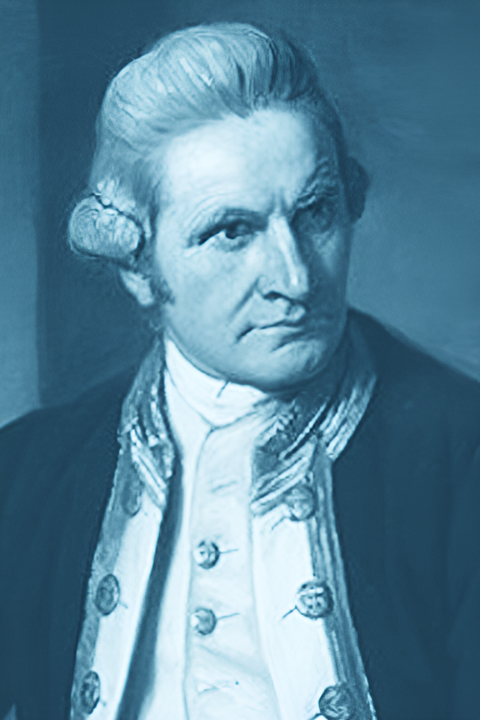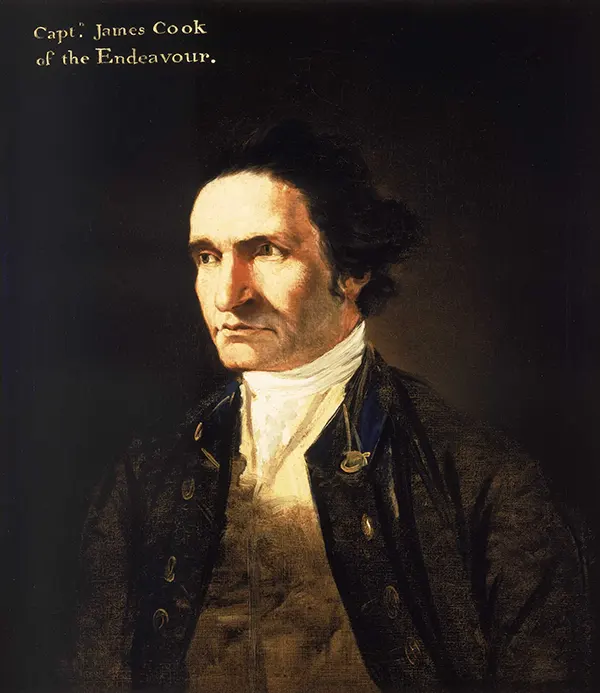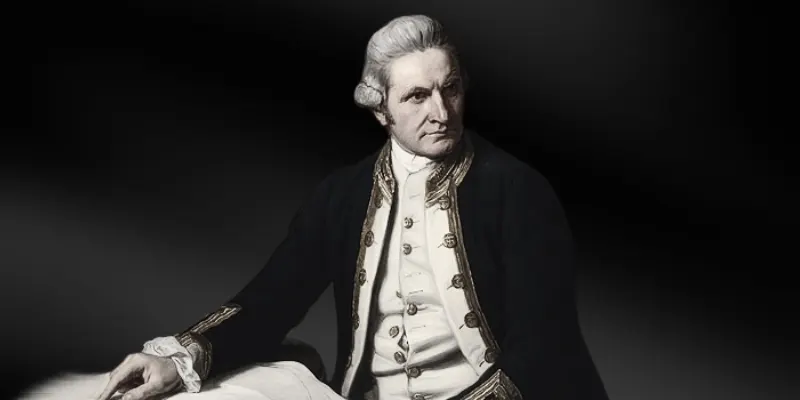
Captain James Cook (1728–1779) was a British explorer, navigator, and cartographer whose voyages laid the foundation for modern knowledge of the Pacific, including Australia, New Zealand, and Hawaii. Born into a modest family in Yorkshire, England, Cook joined the Royal Navy and quickly rose through the ranks due to his skill in navigation and mapmaking. Though not an Antarctic explorer in the same way as Amundsen or Shackleton, Cook was among the first Europeans to cross the Antarctic Circle and prove that no habitable southern continent existed at temperate latitudes. His expeditions combined discovery, science, and diplomacy, reshaping Europe’s understanding of the world.
Achievements
First European to Cross the Antarctic Circle (1773): On his second voyage (1772–1775), Cook sailed farther south than anyone before him, crossing the Antarctic Circle and mapping vast stretches of the Southern Ocean.
Pacific Exploration: Charted the coasts of New Zealand and Australia with great accuracy, and mapped many Pacific islands, including Hawaii, Tahiti, and Tonga.
Scientific Contributions: Worked with botanists like Joseph Banks, collecting invaluable data on geography, flora, fauna, and indigenous cultures.
Circumnavigation: Completed three major voyages around the world, pushing the boundaries of 18th-century exploration.
Accomplishments
Revolutionised cartography with accurate maps that were used for centuries.
Demonstrated excellent leadership and discipline, maintaining the health of his crews (he famously fought against scurvy by enforcing better diets).
Helped expand British influence and knowledge in the Pacific, paving the way for future colonization and scientific exploration.
Advanced the understanding of global wind patterns, ocean currents, and navigation techniques.
Important Facts
Cook’s second voyage in search of Terra Australis (a hypothetical southern continent) proved that no large landmass existed in the Southern Ocean near temperate zones.
He was killed in Hawaii in 1779 during his third voyage, after a conflict with the local people.
He began his career as an apprentice in the merchant navy before joining the Royal Navy.
His maps of the Pacific remained in use long after his death due to their accuracy.